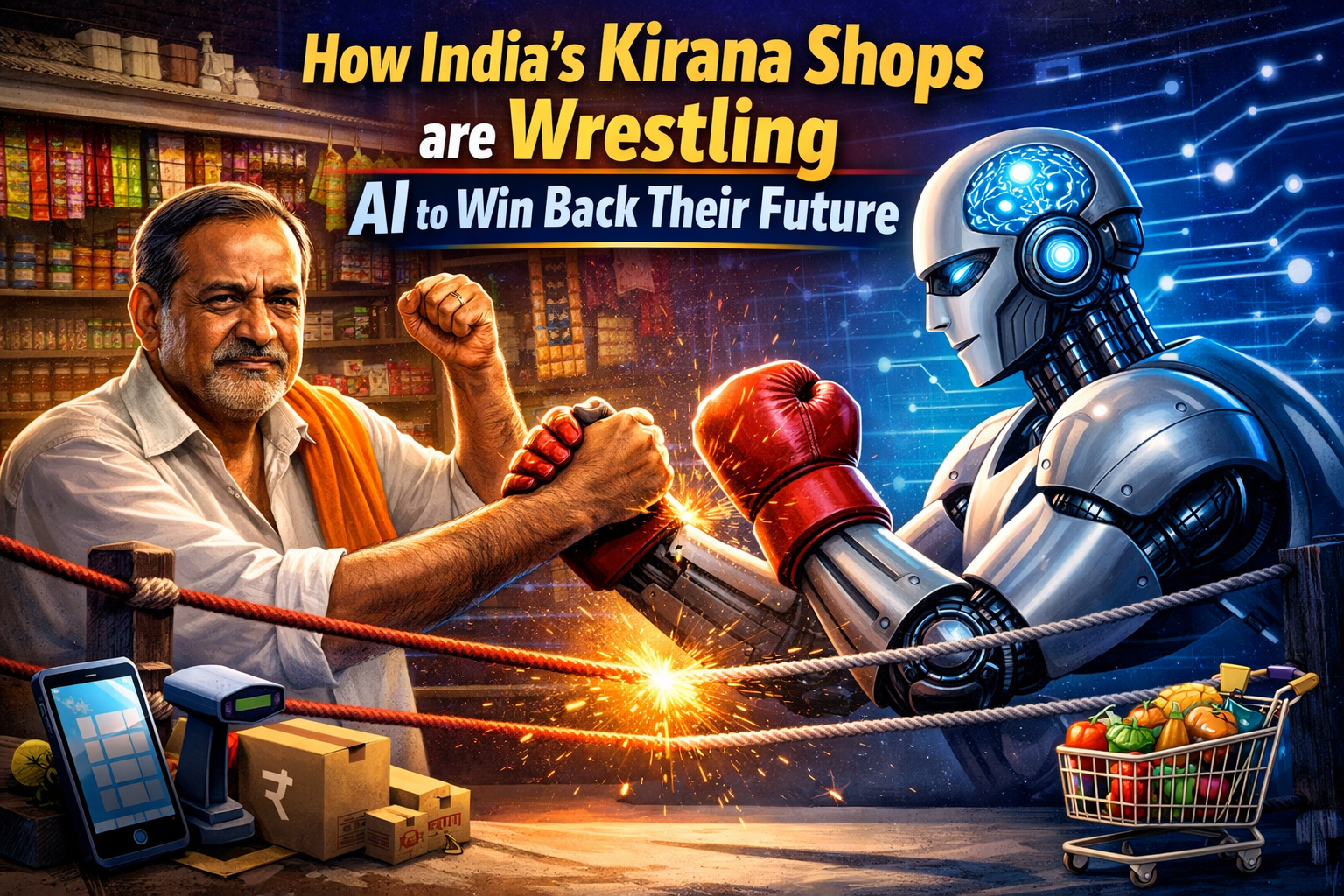
In the heart of a bustling Mumbai lane, amid the symphony of honking rickshaws and the scent of fresh jasmine, Ramesh Gupta* finishes another 16-hour day. He manually tallies soiled ledger entries, eyes straining under a single tubelight, surrounded by sacks of atta and towering pyramids of detergent. For generations, his kirana shop has been a community pillar. Yet, a quiet anxiety gnaws at him. Around the corner, a flashy quick-commerce ad promises delivery in 10 minutes. On his own smartphone, his customers browse endless aisles on e-commerce apps. Ramesh’s struggle is the story of millions. But in pockets across India, a new narrative is emerging—not of displacement, but of a difficult, gritty, and transformative adoption of Artificial Intelligence. This is the story of the struggle versus the result, where the humble kirana is fighting to reclaim its destiny.How India’s Kirana Shops are Wrestling AI to Win Back Their Future
Part 1: The Weight of the Struggle – Why AI Feels Like a Distant Galaxy
For the average kirana owner, AI is not a sleek robot but an abstract, intimidating concept. The struggle to even consider its adoption is multifaceted and deeply human.
1. The Mindset Chasm: “Yeh Sab Tech-wech Mere Liye Nahi Hai”
The primary battle is psychological. Many owners, often in their 50s and 60s, have built their business on human intuition—knowing Mrs. Sharma buys Dalda every Thursday, or that monsoon demands more Maggie packets. Their “algorithm” is in their head. AI seems like a complex, foreign language that devalues this hard-earned, intimate wisdom. The fear is not just of technology, but of obsolescence. “I have run this shop for 30 years without a computer. Why do I need it now?” is a common refrain. Bridging this chasm requires a fundamental shift in identity from a shopkeeper to a tech-augmented retailer.
2. The Cost Conundrum: Every Rupee Counts
Margins in the kirana business are famously razor-thin. Investing in a smartphone was a leap; investing in AI-powered software or hardware feels like a luxury. The direct costs of subscription fees for inventory apps (₹500-2000/month), digital payment terminals, and the indirect costs of time spent learning and data packs, are significant. The return is perceived as nebulous. When survival is a daily calculation, a long-term tech investment seems like a reckless gamble.
3. The Infrastructure Abyss: No Power, No Network, No Data
The glamorous world of AI runs on electricity, stable 4G, and digital data. Millions of kiranas operate in environments where power cuts are routine, network connectivity is patchy, and the only “data” is in a tattered notebook. You cannot train an AI model on absent data. The initial, painful step is digitization—recording every sale, purchase, and expiry manually into an app. This is a monumental task for a shop that sees 200-300 transactions a day, often during chaotic peak hours.

4. The Trust Deficit: “Who Owns My Customer List?”
Data is the new gold, and kirana owners are instinctively wary. Handing over their customer purchase histories, their supplier rates, their entire business footprint to a third-party app raises red flags. Who owns this data? Will it be sold to a larger competitor? Will it be used to lure their customers away? This deep-seated distrust in platforms is a major hurdle. The relationship with the customer is the kirana’s most sacred asset, and any technology that might mediate or threaten that bond is viewed with suspicion.
5. The Skills Desert: “Kaise Use Karein?”
Literacy levels vary. Navigating a complex dashboard, understanding alerts for “predictive reordering,” or interpreting sales trend graphs is not intuitive. The struggle involves not just buying software, but becoming a student again. Who will teach them? Their children might, but they are often away at college or jobs. The learning curve is steep and frustrating, filled with moments where going back to the old ledger seems infinitely easier.
Part 2: The Tipping Point – What Forces Kiranas into the Arena?
Despite these towering struggles, a critical mass of shopkeepers is taking the plunge. The push comes from a potent mix of existential threat and tantalizing opportunity.
The Push of Fear: The rapid encroachment of organized retail, quick-commerce (Zepto, Blinkit), and e-commerce is an undeniable shock to the system. Customers, especially the younger generation, now demand home delivery, digital payment, and a wider variety. The kirana’s traditional virtues of credit, familiarity, and convenience are no longer unique selling points. To survive, they must evolve.
The Pull of Hope: Simultaneously, a new ecosystem is emerging to empower them. Indian fintech and retail-tech startups (like Khatabook, Bijak, Gofrugal, Paytm, Udaan) are building solutions specifically for this demographic. They offer:
- Vernacular Interfaces: Apps in Hindi, Tamil, Marathi, etc.
- Low-Bandwidth Design: Functioning even on 2G networks.
- Phygital Onboarding: Field agents who visit shops, explain, and handhold.
- Micro-Monetization: “Freemium” models with basic free tiers.
Government initiatives like the Digital India BharatNet project and the ONDC (Open Network for Digital Commerce) also promise a more level playing field, reducing dependency on giant private platforms.
Part 3: The Grind of Implementation – Where Struggle Meets Practice
Adoption is never a flip of a switch. It’s a messy, iterative grind.
Phase 1: The Digital Foundation (The First Blood)
Ramesh Gupta starts by downloading a digital ledger app. The first week is chaos. He forgets to log transactions, gets the categories wrong, and his son scolds him for being slow. It takes 15 extra minutes at day’s end. The struggle is visceral—sore fingers, mental fatigue. The initial result? Just a digital copy of his messy ledger. It feels pointless. But slowly, a change occurs. He discovers that the app automatically sends payment reminders to customers via WhatsApp. For the first time in years, chronic debtors start paying up. Struggle: Tedious data entry. Result: Improved cash flow. The first spark of value ignites.
Phase 2: Inventory Intelligence (The Game Changer)
Encouraged, Ramesh explores the inventory module. He painstakingly inputs his 800+ SKUs—name, brand, cost, MRP. It takes him a full weekend. The AI is now awake. It starts showing him alerts: “Kurkure Tomato is running low,” “5 packets of Britannia Bread expire in 2 days.” He ignores it initially, trusting his gut. Then, during a big weekend, he runs out of a popular chips brand and has a stock of expired bread he must write off. The AI was right. He starts following its “reorder suggestions.” Struggle: Massive initial setup, overcoming the “I know better” instinct. Result: 20% reduction in stock-outs, near-zero expiry waste. His working capital is no longer trapped in dead or missing stock.

Phase 3: The Customer Rediscovered (The Secret Weapon)
After three months, the app has built purchase histories. It shows Ramesh that Mr. Kapoor buys premium coffee every month and detergent every two months. Ramesh uses this to send a personalized WhatsApp message: “Sir, your favorite coffee is back in stock. Would you like it delivered tomorrow?” The customer is delighted. The AI identifies that customers who buy ghee often buy organic jaggery. Ramesh creates a small combo offer. Struggle: Learning to use customer data ethically and personally, not spamming. Result: Increased average order value, fierce customer loyalty. He’s not just a shop; he’s a personalized service.
Phase 4: The Business Brain (The Strategic Leap)
After a year, Ramesh looks at the dashboard’s graphs. He sees clear trends: ice cream sales spike not just in summer, but before TV cricket matches; detergent sales rise sharply after payday. The AI’s predictive analytics are giving him a macro view he never had. He uses this to negotiate better credit terms with his wholesaler, confident in his sales forecast. He joins ONDC, listing his shop online, and uses the AI to manage orders from multiple platforms without over-committing stock. Struggle: Interpreting data, making strategic bets. Result: Better supplier terms, new revenue channels, transformed from reactive to proactive business owner.
Part 4: The Transformational Result – Beyond Balance Sheets
The ultimate results transcend rupees and paise.
1. The Reclamation of Time and Sanity: The 16-hour day shrinks to 12. The midnight ledger balancing is gone. The mental load of remembering a hundred things lightens. Ramesh has time for family, for health. The shop, once a tyrannical master, becomes a managed enterprise.
2. The Empowerment of Legacy: Ramesh’s son, an engineering graduate who was reluctant to join a “dying business,” now sees potential. He talks about integrating IoT weight sensors on shelves, or using AI for visual shelf auditing. The business becomes intergenerationally viable, blending traditional trust with modern efficiency.
3. The Democratization of Sophistication: AI is demystified. It becomes “the chotu that never sleeps,” the diligent assistant that handles the mundane, freeing the owner to do what they do best—build relationships, source locally, and be the community’s economic and social node.
4. The Resilience of the Network: When kiranas digitize and join networks like ONDC, they don’t just survive alone; they form a resilient, distributed web that can compete with centralized corporate giants. They become a collective force, powered by local intelligence amplified by AI.
Conclusion: The Human-Algorithm Partnership
The story of AI in kirana shops is not a tech fairy tale. It is a gritty, determined saga of adaptation. The struggle is real, financial, emotional, and cognitive. The result is not about becoming a robotic, impersonal store. On the contrary, it is about using the machine to enhance humanity.
The algorithm handles the trivia of expiry dates and reorder levels. The human handles the nuance—consoling a customer who lost a job and extending credit, recommending a new pickle based on a family’s taste, becoming the trusted source of information and comfort in a crisis. The AI gives Ramesh Gupta the superpower of foresight and efficiency; Ramesh gives the business its soul.
In the end, the kirana shop that embraces this difficult partnership does not lose its essence; it rediscovers it. It wins back its future, not by rejecting the new world, but by smartly weaving the threads of artificial intelligence into the enduring fabric of human connection and trust. The light from Ramesh’s shop no longer barely illuminates his ledger; it now shines a path for an entire ecosystem, proving that in the age of algorithms, the human touch, when intelligently augmented, becomes more indispensable than ever.