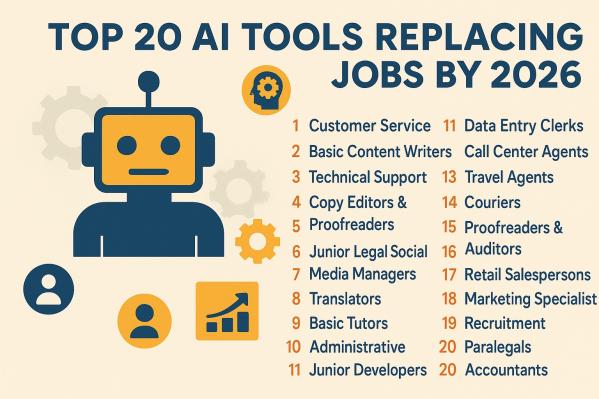
The year 2026 is not a distant sci-fi fantasy; it is a concrete horizon on our business and technological landscape. The conversation around Artificial Intelligence (AI) and employment has evolved from speculative fear to a pressing, practical reality. While headlines often scream about job replacement, a more nuanced truth is unfolding: AI is less about mass unemployment and more about profound job transformation. By 2026, specific tools will automate certain tasks with unprecedented efficiency, dismantling some traditional roles while simultaneously constructing entirely new career landscapes. This article explores the reality of AI displacement, the tangible opportunities it creates, and the viable new career options that will define the workforce of the mid-2020s.AI Tools That Can Replace Human Jobs in 2026: Reality, Opportunities & New Career Options…
The Reality: Which Jobs Are Most Vulnerable?
The reality is that AI excels at tasks that are repetitive, rule-based, data-intensive, and predictive. By 2026, the sophistication of AI tools will mean that “augmentation” will tip over into “replacement” for specific functions. The vulnerability lies not in entire professions overnight, but in the core tasks that define many roles.
1. Administrative & Data-Processing Roles:
- AI Tools: Advanced Intelligent Process Automation (IPA), AI-powered data entry and extraction tools (like hyperscale OCR with NLP), and self-evolving administrative chatbots.
- Impact: Roles centered on data reconciliation, schedule management in high-volume environments (e.g., clinic receptionists, booking centers), basic report generation, and invoice processing will be heavily automated. The job of an “administrative assistant” will shift from typing and filing to managing AI workflows and handling complex exceptions.
2. Mid-Level Analysis & Entry-Level Knowledge Work:
- AI Tools: Next-generation AI analytics platforms (beyond current BI tools), legal discovery AI, AI-assisted radiology and diagnostic software, and automated financial report analysts.
- Impact: Paralegals spending weeks on discovery may see their core task reduced to validating AI findings. Junior financial analysts compiling reports will use AI that pulls data, creates narratives, and suggests insights, forcing a shift towards strategic interpretation and client advisory. Radiologists will increasingly function as overseers of AI diagnostic systems, focusing on complex, edge-case scans.
3. Content Creation (At Scale) & Basic Creative Drafting:
- AI Tools: Multimodal generative AI (text, image, video, sound) capable of producing brand-consistent marketing copy, social media posts, generic video ads, simple graphic designs, and localized product descriptions.
- Impact: Marketing coordinators who produce high volumes of standardized content will use AI as a co-pilot, transitioning to roles as brand voice custodians and multi-channel AI content strategists. Entry-level graphic design for templated work (e.g., social media banners, simple logos) will be democratized, pushing designers toward high-concept, strategic creative direction.
4. Customer Support & Tele-sales:
- AI Tools: Emotion-aware conversational AI that can handle complex troubleshooting, conduct entire sales calls for commodity products, and provide 24/7 personalized support.
- Impact: First- and second-line customer support agents will see a significant reduction in demand. The role will evolve into “conversation escalation specialists” and AI trainers who handle nuanced emotional complaints, complex technical issues, and train the AI on new edge cases.
5. Manufacturing, Inspection, and Logistics:
- AI Tools: AI-driven computer vision for quality control, predictive maintenance systems, and fully autonomous warehouse management and material handling robots.
- Impact: Human quality inspectors on fast-moving production lines will be replaced by AI vision systems with superior accuracy. Forklift operators in structured environments will transition to managing fleets of autonomous vehicles and handling irregular, non-standardized shipments.
The Opportunities: The Rise of the Human-AI Symbiosis
The displacement narrative is only half the story. History shows that technological revolutions eliminate specific jobs but create new, often more complex, industries. The AI era presents four fundamental opportunities:
1. The Elevation of Uniquely Human Skills: As AI handles computation and content generation, the premium on intrinsically human skills will skyrocket. These include:
* Critical Thinking & Strategic Judgment: The ability to ask the right questions, interpret AI outputs in context, and make nuanced strategic decisions.
* Creativity & Innovation: High-concept, original thinking that connects disparate ideas—something AI can mimic but not originate from a place of human experience.
* Emotional & Social Intelligence: Empathy, persuasion, mentorship, negotiation, and building trust. These are irreplaceable in leadership, sales, caregiving, and team management.
* Ethical Reasoning & Governance: Navigating the moral implications of AI decisions, from bias mitigation to privacy concerns.
2. The Democratization of Expertise: AI will act as a powerful co-pilot, making expert-level assistance accessible. A small business owner can use AI for legal document review, marketing strategy, and financial forecasting, tasks previously requiring expensive consultants. This lowers barriers to entrepreneurship and innovation.
3. The Productivity Boom: Automating routine tasks will free human workers to focus on higher-value, more engaging work. This could lead to greater job satisfaction, innovation, and economic growth, potentially creating demand in new sectors we cannot yet foresee.
4. Solving Grand Challenges: AI’s analytical power will accelerate progress in climate science, medicine (personalized drug discovery), and materials science, creating entirely new fields of research and application.
New Career Options for 2026 and Beyond
The career landscape of 2026 will be dotted with roles that sound like science fiction today. Here are tangible new career paths that will emerge or become mainstream:
1. AI Integration & Prompt Engineering Specialists: Beyond basic prompting, these professionals will be conversational architects. They deeply understand AI model capabilities and limitations, and design complex, multi-step prompt sequences to generate sophisticated outputs, manage AI personas for specific tasks, and integrate AI tools seamlessly into business workflows. They will be the “translators” between human need and machine capability.
2. AI Ethicists & Compliance Managers: Every major organization will need professionals who audit AI systems for bias, ensure algorithmic fairness, navigate data privacy regulations (like GDPR), and establish ethical guidelines for AI deployment. This role sits at the intersection of law, ethics, sociology, and computer science.
3. Machine Managers & Robot Coordinators: In physical industries, the role will shift from operator to supervisor. Workers will oversee fleets of autonomous robots, performing exception handling, conducting maintenance, and optimizing system-wide performance. Think “Warehouse Flow Optimizer” or “Autonomous Farm System Manager.”
4. Human-AI Interaction Designers: UX/UI designers will evolve to create intuitive interfaces for human-AI collaboration. This involves designing how trust is built with an AI, how uncertainty in AI suggestions is communicated, and how control is gracefully handed off between human and machine.
5. Synthetic Data Curator & Strategist: As AI training runs into data privacy and scarcity walls, the creation and management of high-quality, privacy-compliant synthetic data will become a critical field. These specialists will generate and refine artificial datasets that preserve statistical integrity without containing real personal information.
6. AI-Supported Healthcare Roles:
* Personalized Health Coach: Using data from wearables and AI diagnostics to provide daily, tailored lifestyle and health advice.
* Surgical AI Navigator: A specialist in the operating room who manages and interprets real-time AI guidance during robotic surgeries.
7. Legacy Workforce Transition Specialists: A meta-role that will be in high demand. These are consultants and trainers who specialize in reskilling employees whose jobs are being transformed by AI, focusing on the human skills and new tool literacy required.
8. Creativity Amplifiers & Editors: In creative fields, the job will move from creation-from-scratch to high-level direction and refinement. “AI Art Directors” will conceptualize and guide AI tools to produce cohesive campaigns, while “Generative Content Editors” will specialize in adding the nuanced human touch, cultural context, and emotional depth that raw AI output lacks.
Navigating the Transition: A Actionable Path Forward
For individuals and organizations, the path to 2026 requires proactive adaptation:
For Individuals:
- Embrace Lifelong Learning: Adopt a mindset of continuous skill adaptation. Online platforms, micro-credentials, and company training will be crucial.
- Double Down on the “Human Edge”: Consciously develop creativity, empathy, complex problem-solving, and leadership skills.
- Become AI-Literate: Don’t just be a user; understand the principles. Learn to work effectively with AI tools in your field.
- Cultivate Versatility: Build “T-shaped” skills—deep expertise in one area, complemented by broad collaborative skills across disciplines.
For Organizations & Educators:
- Invest in Reskilling, Not Just Hiring: The most sustainable path is to transform your existing workforce.
- Redesign Jobs Around Augmentation: Audit roles to identify tasks for automation and reinvest human hours into higher-value responsibilities.
- Revamp Education Curricula: Schools and universities must integrate critical thinking, ethics, and AI collaboration across all subjects, moving away from rote memorization.
Conclusion: Replacement or Renaissance?
By 2026, AI tools will have irrevocably changed the nature of many jobs. The notion of a stable, 40-year career in a single, unchanging role is fading. However, to frame this solely as “replacement” is to miss the larger picture.
We are standing at the threshold of a work renaissance. AI is poised to unshackle us from the monotonous, the repetitive, and the purely computational. The challenge—and the immense opportunity—lies in our ability to adapt. The jobs of 2026 will not be about competing with AI on its terms but about leveraging its power to amplify our uniquely human capacities for insight, creativity, and connection.
The future of work is not human versus machine. It is human with machine. The most successful professionals in 2026 will be those who master this symbiosis, turning the reality of automation into an unprecedented opportunity for growth and innovation. The choice is not whether this change will happen, but how we choose to meet it.